norcal
- Nov 19, 2025
- 8 min read
Updated: Nov 24, 2025

Last Monday morning, I woke up and took my beloved BART to Embarcadero station and walked the few blocks to the San Francisco ferry building. Even the city's downtown, despite its generally impersonal, imposing big-city surface, manages to awaken my nostalgia and love for San Francisco--
The haunting chuckle of accidentally taking an LSD-laced edible at my first SF Pride Parade, getting completely lost amongst the crowds. Mistakenly taking my friends on the train to Oakland and back, sitting in my slutty gay outfit at the Westfield mall sipping water and wondering if everyone in the mall knew we were on drugs. Staring at bare-breasted women emerging from the BART station like missiles of freedom from the underground and learning about an embodied future I didn’t know existed.
Singing and shouting “el pueblo unido jamás será vencido” with tears running down my face at the Women’s March in 2017, cursing Donald Trump in those early days of his first term, looking around me at bodies and voices emanating power, love, righteousness, feeling something deeper and wider than I knew possible—knowing these are my people, my tribe, my comrades.
Sitting atop the San Francisco Zen Centre’s Pride float, years later, with my soon-to-be-partner (who was dressed in a Buddha costume), and crying at the solidarity of our movement, again. Running into my gay cousin and really seeing each other, grown up and growing up again, in our shared culture and community, knowing what it took us to get there, together.
When I am downtown in San Francisco, I think about the earthquake-proofing of the skyscrapers, their big bones, and the feeling of the streets shaking from feet that know freedom, and the enigmatic potential of tech executives pouring out of art deco buildings on their electric flying skateboards, and the multi-million-dollar sculptures sitting like sentries between the buildings in all of their opacity and grandeur. I wonder at a city where power converges and transforms and sometimes changes the world.


It is hard to be proud to be an American, but easier to be proud to be a Californian, and a staggering blessing to have come of age in San Francisco. I know these flags mark colonial states and cultures, and I also know they represent something on the rugged edge of freedom. When I look at these flags, I see Harvey Milk, and Angela Davis, and Ursula K. Le Guin, and Starhawk, and Malcolm X, and the Black Panthers, and the Faeries, and Cesar Chavez, and so, so, so many more harbingers of belonging. And I am proud, so much so that it tugs my chest open, to walk behind them.


A drawing from 2014 of my sister and I at the ferry building, which my parents serendipitously returned to me the day I arrived in California last week - from my high school studio art capstone project about memory!
When I first moved to the Bay Area at 14, my parents brought my sister and I to the ferry building for lunch, and it is one of my first memories of San Francisco. I remember trying to feel the city out like a new tooth in my mouth. Walking down this hallway last Monday, I was struck by the passage of time, thinking how much has changed in our family since that day, and, simultaneously, how a place once completely unknown to me now holds snapshots of not just my own histories, but those of generations of my family.




I was surprised, as I wandered the ferry building, by how many of the restaurants and businesses held meaning for me – Mariposa Gluten-Free Bakery in Oakland, where I worked for a year when I dropped out of undergrad to have my mental breakdown and spiritual awakening (and dated the Buddha costume-wearer). Gott’s, the burger joint my mom went to growing up in St. Helena, and where our family would eat whenever we visited my mom’s parents in Angwin, flying in from whatever state we were living in (or country we were traveling from) at the time. Equator Coffees, the coffee shop that opened up in Mill Valley when I was in high school, where my parents and I would walk for breakfast sometimes with our beloved dog, Jasper. Cholita Linda, the upscale taco place near the co-op I lived at in Oakland, Roots & Branches.
It hadn’t occurred to me until I walked through the ferry building that these businesses, like land, or songs, could hold so much memory—but of course, food, restaurant cultures, or iconic branding can create spaces of continuity that our mortal little lives intersect in and out of. Eating the same dishes year after year, at the same special bench, or, luckier, with the same special server, is like catching up with an old friend, a Giving Tree. These spaces hold relationships, memories, and traditions for us wee humans when our lives are too full, or too complicated, or too painful to uphold those connections with our own hands and brains, in our quotidian sprawl.
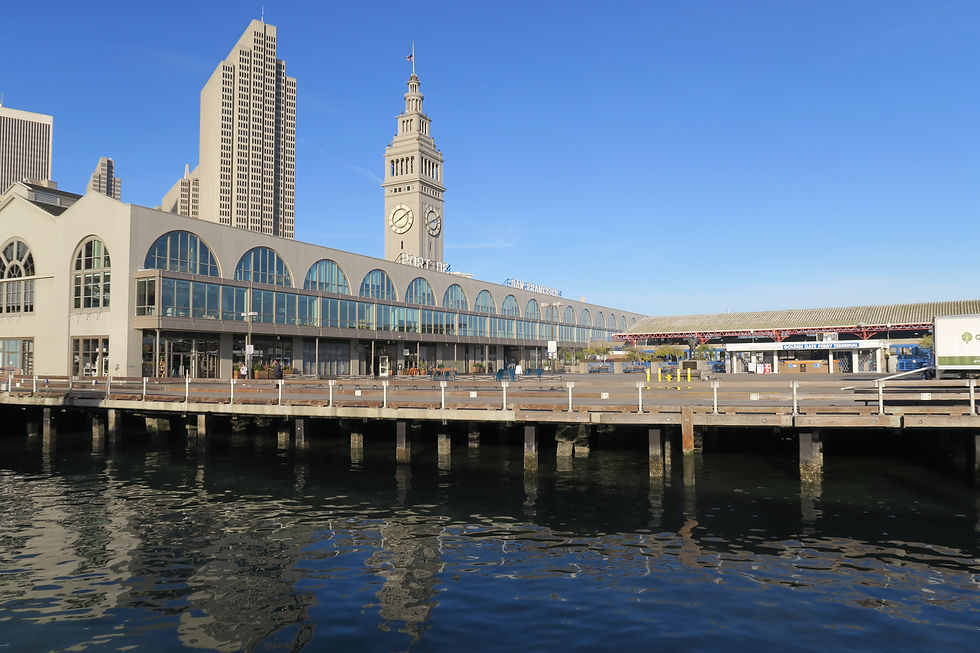
Waiting for my boat to Vallejo to arrive outside of the ferry building, I thought about ferries, about BC Ferries vs. San Francisco ferries, about the Port of San Francisco, or the Port of Oakland, vs. the Port of Prince Rupert. Distribution networks. Global trade. Food. Shipping containers. Racialization. Colonization. Belonging. Culture. Language. Place-names drawn from saints versus oaks versus princes. Place-names forgotten, place-names erased, place-names remembered. So much history wades through these port(al)s.
The flag of the United States of America, waving atop this port beacon, complicatedly. And the water waving below, holding memories, complicatedly.

The Bay Bridge, connecting San Francisco to Oakland and the East Bay, which I crossed underwater on BART and overwater by car when I lived in Oakland, sometimes to visit lovers, often to go bathe myself beyond my means at the Kabuki Springs & Spa, and more often yet to visit my mother in the hospital(s) while she recovered from her brain injury.

The Golden Gate Bridge, connecting San Francisco to Marin, which I travelled across every day in high school, whether by car, bus, or once all the way by foot. When I was a young child, before we lived in California, my family of four took a trip to San Francisco and rode across the bridge on tandem bikes. I was riding behind my mother and singing to myself the whole time, because I was scared. I thought nobody could hear me singing, but years later, my mother chuckled about my little melodies, and I felt less alone.
My father biked across this bridge every day for work for years, and my mother had the cycling accident that changed her life on its burnt orange rails.
On the right, Alcatraz Island, the famous prison, where I once saw an Ai Wei Wei exhibit that totally transformed my understanding of freedom.

My beloved city.

Mount Tamalpais, whose foothills I climbed almost daily in high school, where my father mountain biked almost daily, and around whose circumference and over whose peaks and valleys I came and went throughout my California years, in countless tides of falling-in-and-out-of-love with my various passengers, chauffeurs, and companions. Over the other side of Mount Tam, the seaside town of Muir Beach, where I spent time at Green Gulch Zen Center, stepped off the beaten path of my own life, and saw my beautiful friends get married. Beyond that, Point Reyes National Seashore, where my spirit feels free and the sea calls me home.
Not pictured – the Richmond Bridge between Marin and the East Bay, which I traveled across weekly when I lived in Penngrove (farm country) to go see my therapist, friends, and various lovers in Oakland.

My parents picked me up in Vallejo and we drove up to Angwin at the top of Howell Mountain, my mother’s childhood home. My parents live there now. The great oak on the land now serves as a namesake for the property’s sustenance, Great Oak Vineyard. It was my first time back in Angwin after many years, and the land had changed – western pine beetle and drought have cleared at least 50% of the trees on the property, and the vineyards, which have expanded over the years to make the property financially sustainable, have cleared many of the rest. I felt a great loss at the emptiness where my childhood climbing trees had stood like benevolent grandfathers, and though I searched the remaining stands for the madrone tree where I had carved my middle school crush’s initials, it too was gone.
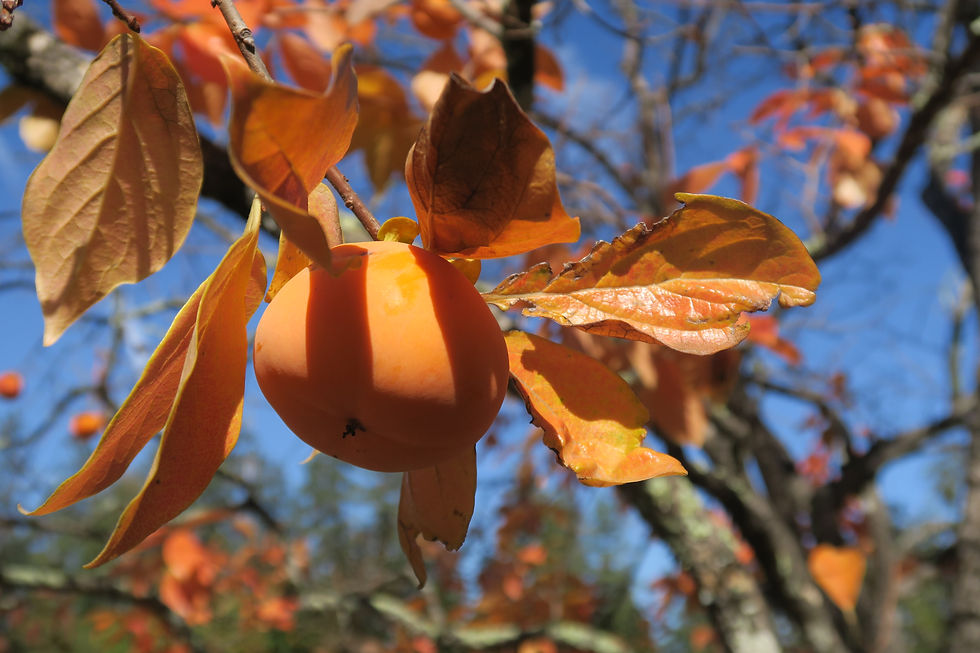
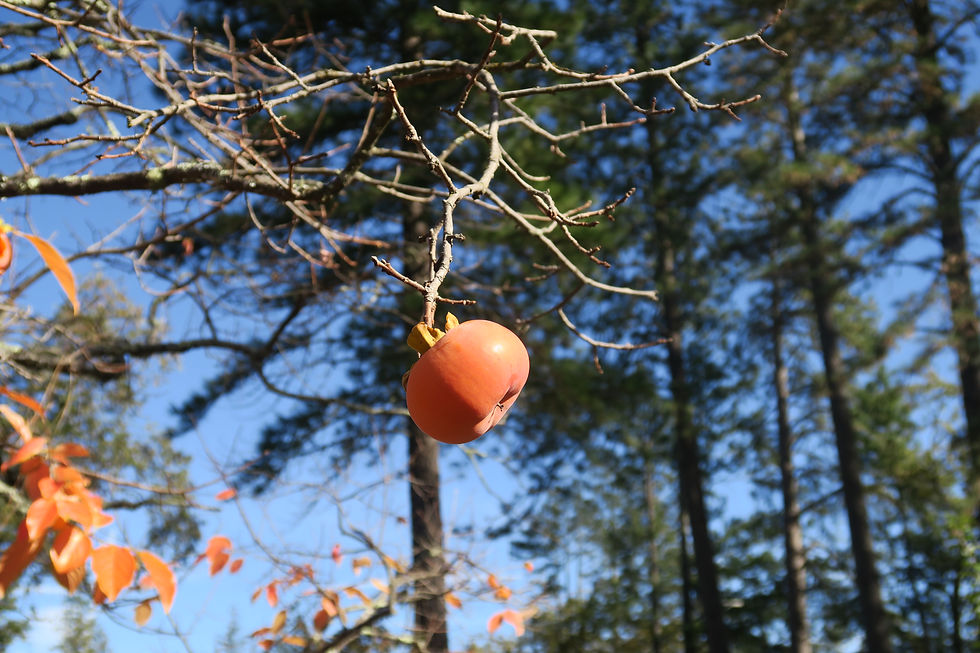
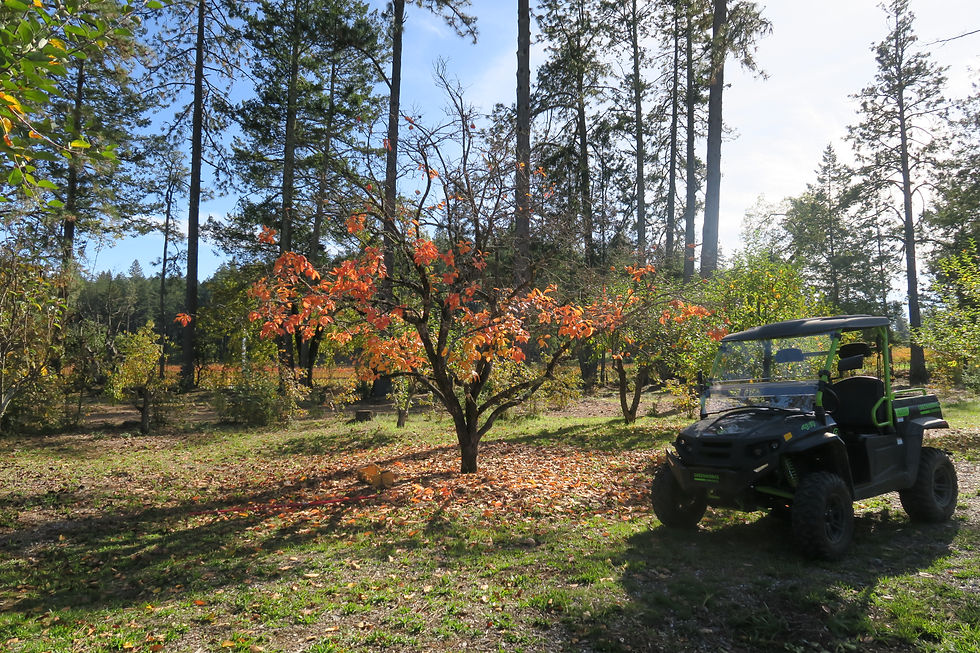
My father and I picked the persimmon tree clean before the coming rains, and talked about farm economics. It was nice, and new.


I wondered how the fruit trees could be so fertile and upright after 50 years, and how they could be the same trees I remembered from my childhood visits, the same trees my mother told tales of from her own youth, riding her horses bareback through the surrounding woods, sleeping in the barn to avoid her family.
I learned that my grandfather, a heart surgeon, had brought discarded blood home from the St. Helena hospital each week and made my mother responsible for spreading that blood around all the tree roots.
I am not sure how to integrate that information.

My parents’ beloved beehives, which soften me to them. Once, a new hive got loose in my mother’s car during a three-hour drive and she remained stoic, letting the bees sting her and fly all about the vehicle, refusing to lose the hive and ensuring the bees arrived safely to their new home. For weeks afterward, remnant bees would fly out of crevices and crannies in the car, once even stinging our poor dog on the nose!

The sign outside my parents refurbished barn, which makes me happy. I am glad they have found joy and comfort in the land.

A wine barrel with the vineyard logo I designed years ago. I have complicated feelings about my relationship to this land and to my parents’ legacy. I want to take responsibility for my connection to both land and legacy. I am learning how to be part of it. Years ago, I paid homage to the property’s great oak through an afternoon of drawing, immortalized now as part of my parents’ story of the land.
I wonder if one day I will manage this wine business, and the property, and what that means about my life in Canada, and what that means about who and where I come from in California, and how to honour all the land across continents that shaped my ancestors before me.

My parents shared a story with me one evening over dinner with their friends. The story surprised and moved me greatly, and left me with questions about what comes next.
tonight i learned a story of my mother’s soul, on the land of her parents’ ashes and their patients’ blood, and my parents’ tears and peace and laughter
my mother’s parents gave each of their five children a different set of instructions for where to lay their bodies to rest at the end of their lives
when my grandparents eventually died, their children split the ashes of their parents into five parts. four-fifths of my grandparents rest in the angwin cemetery
as my father tells the story, my mother kept her share of her parents’ ashes in an urn on the mantle of the fireplace for years, without a word in passage
one night, not too long ago, my mother woke suddenly, a few hours past midnight, in the darkest shadow of the night. she turned to my father and said, “it is time to bury my parents”
in the darkness, my mother drew my father out with her to the fruit orchard to spread my grandparents' ashes under a full moon, among the sleeping beehives
later i learned that my grandfather, a heart surgeon, for years had fed the roots of his fruit trees with the discarded blood of his surgical patients, cycled through the heart-lung machine in quarts per hour, donated to medicine by unknown souls and donated to the land by my grandfather’s will and my mother’s hands to fig, apple, plum, pear, persimmon, grape, blackberry, and once upon a time, if i recall, to peach
fifty years later these trees stand tall as deities and still i climb them like my own mothers’ arms
their fruit is sweet and full of stories, and the land speaks of generous souls, my grandparents’ hands, waters of life and death, and the hopeful buzzing of the youngest among us, ferrying pollen from blossom to blossom, dancing over ashes, and stinging open broken hearts