loma linda
- Dec 4, 2025
- 12 min read

The day after arriving by train at my (paternal) grandmother's in Santa Barbara a couple of weeks ago, I continued my family lineage quest to Loma Linda, by car, to the home of my (maternal) great-aunt Maureen. Loma Linda is the Californian heart of the Seventh Day Adventist Church and especially of its healthcare empire-- pictured above is the monolith that is the Loma Linda University Medical Center. Both of my parents grew up (very) Seventh Day Adventist and left the church in their early 20s. Though I was not raised religiously Adventist, I have recently realized that in many ways, I was raised culturally Adventist (cue some invisible and barely-processed Christian trauma).

For the drive from Santa Barbara to Loma Linda, my (Adventist) grandmother prepared me a bag of cookies and a map of California. This was just about the most grandmotherly gesture I have ever received and I had no idea how to handle it. I did eat all of the cookies. They were gluten free!
My cookie-baking grandmother of course goes way back with my (also Adventist) great-aunt in Loma Linda, and sent her good wishes along with me. All Adventists know each other. Kind of like queer people, except... different.
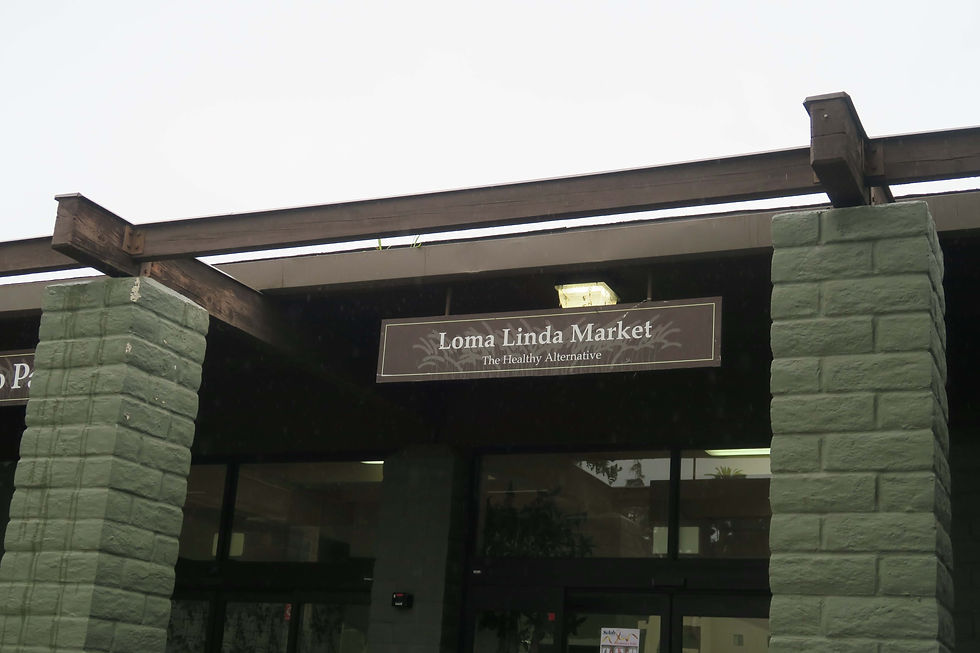
I had to pee and was nervous to meet Maureen, so I ducked into the local market for a quick carrot snack and a bathroom. I had no idea what I was getting myself into!
The Loma Linda Market tickled something in the oldest recesses of my mind, and tiny fables started to crawl their way forward into consciousness. A feeling that had started to wash over me since pulling off the highway into Loma Linda landed full-throttle in my temples and my chest - remembering!
I recently learned that my mother spent her early childhood near her much-loved paternal grandmother, Doris (Maureen's mother), in Loma Linda before moving up north to Angwin in the 5th grade. When my mother told me about this move--once on the phone, and once over dinner--her voice and demeanour changed completely as she described the shift, from soft to hard, warm to brittle. Her voice sounded like the end of childhood. When I asked why her family had moved, she told me that her mother, Margaret, was too warm in Loma Linda and sought out the cooler temperatures of Angwin's Howell Mountain - a landscape somewhat more reminiscent of England, Margaret's country of orifin.
From the little I know, my mother was somewhat unhappy during her childhood and young adulthood in Angwin. She attributes much of this shift to the cultural differences between "Loma Linda Adventists" and "Angwin Adventists" (apparently, Northern Californian Adventists are the most hardcore). She says Loma Linda Adventists are "different," and are what Adventists are "supposed to be."
Funnily enough, I have my own narrative about ~the end of childhood~, which I mark by my family's move from New Jersey to Ohio when I myself was in the 5th grade, and which I have historically held with just as much grief, fracture, and resentment.


At some point during my middle school years in Ohio, in fact, one of the staples of my childhood joy disappeared: Little Links. There was a supply shortage, I had a newfound gluten intolerance, and my regular breakfast of scrambled eggs, Little Links, and ketchup was replaced by miso soup and other eating disorder specials.
Little did I know that Little Links, which I consumed with glee from our New Jersey breakfast nook in five tiny bites per link, each dipped in ketchup, came from the heart of Adventist health culture, the Loma Linda Market! Nor did I know that all of the other veggie meats my mother cooked with - FriChik, Nuteena, Linketts, and all of their brethren, came from this holy mecca of militant vegetarianism.


Behold: the Titans! The monuments of an empire!
I walked down this aisle of icons and was flooded with memory after memory of childhood meals, of my mother in the kitchen, of the glorious smell of the Maillard reaction, of the magic of tasting so many tastes for the first time.
I paid my respects to each giant can, humbled to realize that I had a relationship with almost every one of them, and somehow devastated by the ones I didn't know.

I had thought I was on a carrot pit stop at the Loma Linda Market, but really I was possessed, drawn almost magnetically to this place full of knowledge, a collage of a culture I didn't know my childhood had been so very constructed by.
After paying my respects to the can-gods, I was unable to stop myself from picking up a can of Little Links. I knew I couldn't eat them because they are full of gluten, and that I couldn't bring them on my carry on bag back to my mother in San Francisco or to my vegetarian friends in Vancouver, because the can is full of liquid. But I simply had to have them. Peering into the image on the can, I was seven years old again, about to climb a giant tree with my best friend and across-the-street-neighbour, Jack, then get the neighbours called on me for my rascal-like behaviour and blatant disregard for private property, then scuttle home for whole wheat toast with Earth Balance and Marmite and maybe a glass of soy milk.
(In the end, I gave the Little Links to my grandmother in Santa Barbara after holding onto them for days like a baby blanket)


Soymilks! Tofutti Cuties! Bob's Red Mill! Peanuts! I was one of Plato's cave dwellers exposed to the figures behind the shadows, realizing that in every Stop N' Shop, Kroger, Whole Foods, and Costco, my mother was going aisle to aisle recreating the Loma Linda Market in our shopping cart, where I sat plopped in the child seat desperate for treats. Every staple of my childhood in one place, found (and ordered online) over and over again as we moved state-to-state-- not just my mother's preferences but her culture. Chosen for her, imbued in her, and fused to my own wee taste buds.


What other keys could this god-like grocery store hold? Ah yes, a prolific vitamin section, foreboding my family's neurotic vitamin obsession and collective hypochondria. And, closer. to home, a bulk herbs, tea, and spices section, perhaps foretelling my own pathway to traditional herbal medicine!
As it turns out, the Loma Linda Market was a panoply of oracular objects and schemas, each aisle a proclamation of the Ten Commandments of my (Adventist?) childhood.
I myself have, for better or worse, turned out a health-obsessed, soymilk-loving, neurotic and highly spiritual person. And still, I walked around this grocery store with my shitty dye job and my dykey tattoos, gawking with my little camera, crawling out of my skin from the Puritanical Christian cultishness of it all while also feeling somehow perfectly at home. I split!
My cousin, who was raised full-blown Adventist, once told me I would make the perfect Adventist: rural, mostly vegetarian, obsessed with tea, an avid hiker, in bed before 9pm, mostly sober, overly diagnostic, and ethically perfectionistic. I countered that this was my lesbian culture in action. Apparently, there is a Venn diagram here which inches closer to a circle than I ever could have imagined.

Was I surprised when I arrived at holy library of the grocery store, replete with biblical stories and the entire collection of Adventist prophet Ellen G. White's writings (not pictured)?
I was not. The Loma Linda Market is a one-stop-shop for a way of life, one which--now apparently--I had been secretly shaped by.
Funnily enough, in this moment I thought of the stack of Jewish books I had waiting for me at home in Gibsons, part of my new, shy little foray into Judaism. I wondered with a shiver: knowing Adventists are culturally sort of obsessed with Jews, is it a coincidence that I am now drawn to my Jewish heritage? Or, what do I call my library of earth-based spirituality, my own deific relationship to Brandi Carlile, or Judith Butler, or James Baldwin?

I was surprised to see an "ethnic" aisle in the Loma Linda Market, and to recognize some of the products in that aisle, again from my own childhood (coconut milk, etc).
In general, the Adventists I have met in my family circles have been quite racist and not-subtly eugenicist, in addition to being highly patriarchal, homophobic, classist, and infinity and beyond.
My surprise at the inclusion of ethnic foods curdled when I realized that the fruits of the aisle did not necessarily sit in contradiction with my perception of Adventists and their Christian white supremacy.
For, as I was about to learn in much clearer detail, there is an intimate relationship between Seventh Day Adventism, healthcare, and evangelical colonialism.

Driving away from the emotional Area 51 of the Loma Linda Market, I noticed this "Blue Zone" poster positioned proudly on the street lampposts.
Ah, what a designation. Blue Zones, popularized by Nat Geo poster child Dan Buettner, are purportedly dotted around the globe and known for their healthy, happy populations with long lifespans and perfect BMIs. Blue Zones LLC was acquired by Adventist Health in 2020. A 2023 TV miniseries includes an interview with Loma Linda resident Dr. Brian Bull, my great-aunt Maureen's late husband.
The Blue Zones project quantifies and qualifies well-being in unique communities-- my Masters thesis qualified and storied well-being in a unique community. The Ecuadorian Andes, where I did my Masters work, has its own informal Blue Zone(s). In 2023 and 2024, my primary Ecuadorian research collaborator and close friend, Rosa, traveled with me to visit my (very Adventist) family in Providencia, Colombia -- my (paternal) grandmother's ancestral Caribbean homeland. I told Rosa about Adventism in my family, my complex relationship to religion, creole Raizal identity, diaspora, estrangement, womanhood, and belonging, and she told me tales of her own Adventist friend back in Ecuador.
Is this what it looks like to iterate and permutate and palimpsest lineage?

After my pit stop at the market, I arrived at my great-aunt Maureen's driveway, full of curiosity and nerve. When I had told my parents I was planning to visit Maureen, they warned me about her very steep driveway. Cautiously, I asked them if we had perhaps visited Maureen's home when I was a very young child. They said yes, when you were two. I asked if we, by chance, had backslid in our car down her driveway and temporarily lost control of the vehicle. They said yes, most likely, a bit sheepishly.
For as long as I can remember, I have had a recurring nightmare about sliding backwards down a steep driveway, sometimes from the backseat, sometimes from the driver's seat, the car so heavy and the road with no purchase, losing control myself or subject to falling at someone else's hand. I wake up from this nightmare short of breath and upside down, beyond physics.
Turns out, that nightmare was a memory!
I always thought it was a metaphor for my control issues (and maybe it is). But maybe it was also my first taste of mortality, and of my parents fundamental inadequacy as mortal human beings, not gods, and my own aloneness in the face of death.
Anyways, I decided I must face the driveway once and for all, and so I did, heart racing. I didn't backslide!

I was greeted by Maureen, who is 92 years old and British as ever. She fed me Thai food for lunch, stymied and clearly a bit put off by my inability to eat gluten or dairy - just before I left her house, later, she warned me not to die from malnutrition. Lovely.
Maureen's kitchen was full of hand-painted plates made by her sister, which were complemented around the house by generations of story-filled statues, knits, paintings, and most of all, photos.

Before we dove into photo-land, Maureen saw me ogling her garden and offered me a tale of my mother: "when Valerie was a child, she came over to play with Beverly (Maureen's daughter) and saw Beverly's playhouse (off the the right, not pictured). Valerie took one look and said, 'I am going to have one too, but it will be two storeys!" Maureen chuckled and said my mother's comment made an impression.
I'm not sure I have ever heard a story told about my mother as a child before! It was fascinating. For context, my parents are both estranged from all of their siblings and parents, and they shared very little about their childhoods when I was growing up.
I loved imagining my mother crawling around this beautiful garden, and felt a pang of sorrow and empathy for her, hearing jealousy in this tale. My mother was the youngest of five, and I wonder if she wasn't a bit lonely as a child. I know what it's like to want the things that other families offer, especially when they are full of magic and whimsy and nurturance.

Up next: a journey through my mother's line, captured in a photo book created by my mother's aunt Maureen, storykeeper at the top of the steep drive! There's my mom in the little navy sailor dress, with all of her siblings, her parents, some cousins and aunts and uncles, and her grandparents.
Here comes a tale of two by twos intertwining across lands and seas:

Otto Huse, my great-great-grandfather, and his parents, peasant farmers from Prussia.

Queen Victoria of England commissioned Prussian farmers to colonize New Zealand. Otto was disguised a girl to avoid mandatory military service in Prussia.

Otto grew up in Jackson Bay, NZ, and married a British woman, Hannah Dale. They had 8 children, including Arthur, my great-grandfather.

Arthur earned enough money working on the family farm in NZ to attend university. At university, he became a Seventh Day Adventist. Unable to attend required Saturday classes because he observed a Saturday Sabbath (just like my father!), Arthur chose to transfer schools to the College of Medical Evangelists in Loma Linda.

Catherine Reeder, my great-great-grandmother from England.
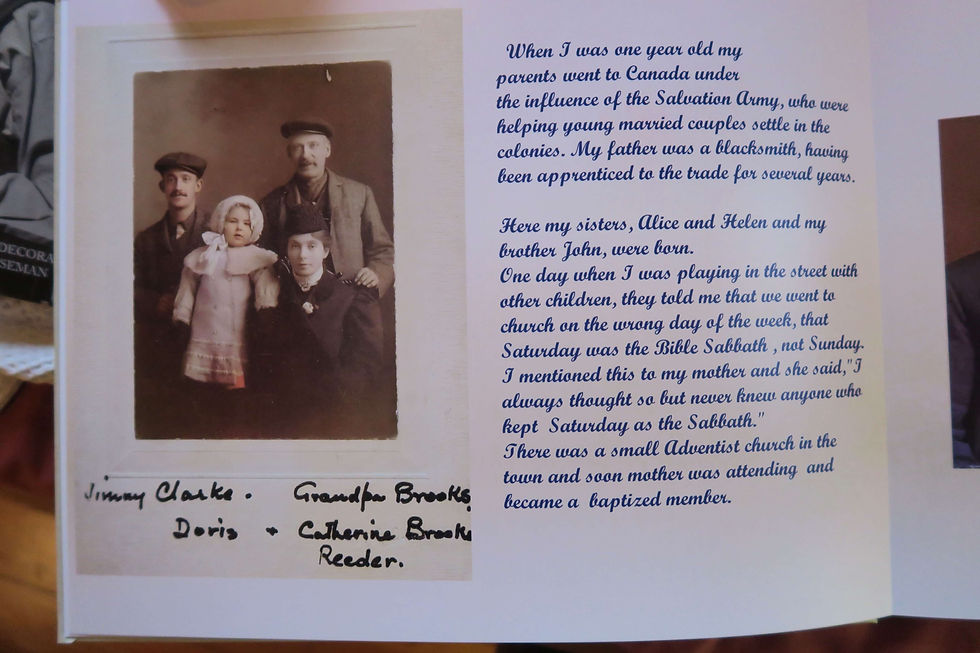
Doris Reeder, my great-grandmother, who moved from England to Ontario, Canada at age 1, where she and her family joined the Adventist church. Her father, a blacksmith by trade, joined the army during WWI and left for Europe.

Doris's childhood home in Canada, which still stands today with the same rose bush out front. They lived just kilometres away from my paternal great-grandmother at the time. Unknown to each other, their great-grandchildren (my parents) would one day be married!

Doris's family moved back to England after the war because Canada was too cold. Doris moved to the U.S. as a young adult to train as a nurse in Washington, D.C.

Arthur and Doris meet in Washington, D.C.! They are smitten and get engaged.

Arthur graduates from Loma Linda University, where he and his friends helped build the university's first amphitheatre for their graduation ceremony!
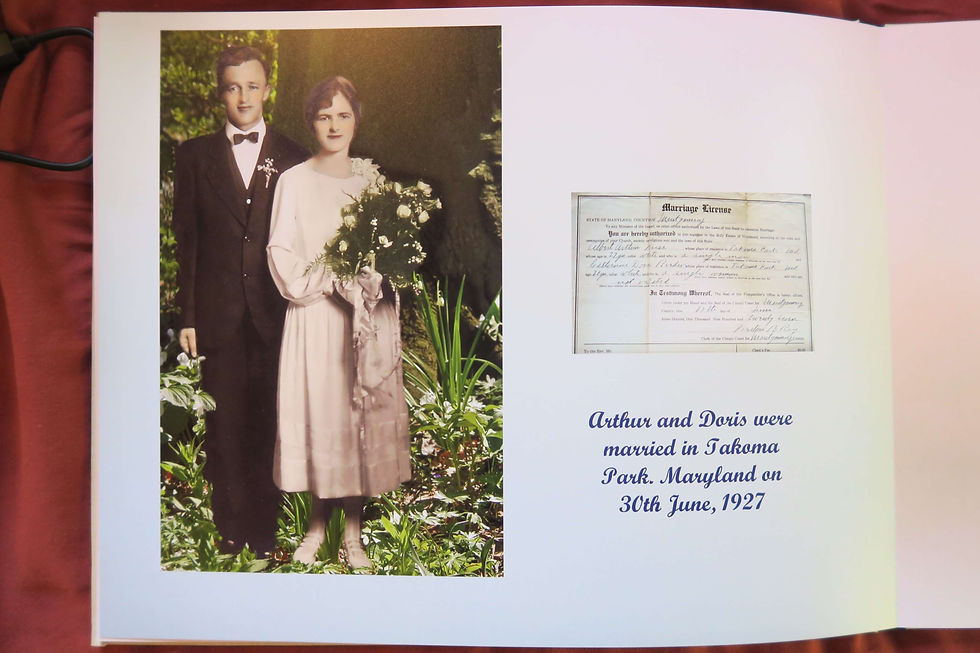
Arthur and Doris are married! In Takoma Park, Maryland, minutes from Silver Spring, the global administrative heart of the Seventh Day Adventist Church.

Arthur and Doris sail to Botswana. They engage in religious colonialism, or medical evangelism, on behalf of the Seventh Day Adventist Church.
I will note here that my access to this highly-documented archive of family history is made possible only by the archival hegemony of Anglo-Saxon white supremacism, and that the characters of these stories--my ancestors--were purveyors of religious and cultural violence against Black and Brown histories and Black and Brown people through settler and mercantile colonialism. As agents of geopolitical power channeled through medical evangelism, my ancestors and their white contemporaries rewrote narratives of geography, culture, economy, gender, sexuality, and race. I can only imagine the stories they obfuscated, and the lacunae in the archive that I have subsequently inherited (see Saidiya Hartman re: archives).

My mother's father, Wilfred, was born to Doris and Arthur in Zimbabwe, then called Rhodesia, governed as a British colony. Like his grandfather Otto, Wilfred's eventual migration to the U.S. as an adult was largely defined by avoidance of mandatory military service. When Wilfred was informed that he was to serve in the Rhodesian military to fight for independence from Britain, he chose to apply for U.S. citizenship instead.
I can't help but think about how so many of us migrate away from gendered sentences (like little Prussian Otto, in drag!), and I wonder how much of my immigration to Canada is informed by my queer panic under the Trump Administration, or rather by fleeing the southerly California heat for cooler northern climes, like my mother's mother.

Most of Wilfred's childhood took place in Birmingham, England, where Maureen, his sister, recalls biking the idyllic cobblestone streets together and staying the night in youth hostels to explore the British countryside.

Wilfred went on to become quite an accomplished heart surgeon. Somewhere along the way, he met Margaret, my mother's mother. I don't know that story yet!

The family again. Wilfred in a striped blue tie behind my mother, his daughter, who wears a green dress. My mother's mother, my grandmother, sits in front of my mother in a printed dress and white sandals. Doris sits in the middle in a powder-blue suit, Arthur behind her.

After walking me through her brother Wilfred's story as told by her photo book, Maureen brought me up a flight of stairs to her woman-cave, a.k.a her archiving office full of filing folders, photo negatives, scrapbooks, and a double-monitor computer setup with meticulously filed digital photos and videos from her long, storied, and well-traveled life (she laughed at me when I awkwardly asked her, in an attempt at small talk, if she had traveled much).
Maureen proceeded to show me my parents' wedding video, which she had filmed, and which I had never seen. It was an inexplicable experience for me.
Finally, Maureen showed me a photo (above) that she had taken at my parents' wedding, which shows Doris, my mother's grandmother, holding hands with Lilith, my father's grandmother. Apparently, they were friends. All Adventists know each other!
---
Foreshadowing: also trotting around my parents' wedding video was my aunt Megan (my father's much younger half-sister), just a little poof of a toddler, hand-in-hand with my grandfather, my father's father.

And so on I went, time-jumping and highway-driving from verdant Loma Linda to the Palm Springs desert to visit that very same grandfather, now 88, and my aunt Megan, now 36, and a new 5-week-old little one of her own!